Category: Android Errors & Fixes

Running into Android errors on your phone? Find fast, reliable solutions here. We help you fix common problems like “app has stopped” messages, Google Play Store errors, system update failures, and battery drain issues.

Our guides work on all Android devices including Samsung, Xiaomi, Oppo, Realme, and Vivo. Each tutorial is tested on real phones and written in simple steps—no technical knowledge needed.

Search for your specific error message above, or browse our latest fixes below. Most Android problems can be solved in under 5 minutes without losing your data or resetting your phone.

  • Samsung Galaxy S26 Ultra Screen Problems: Complete Fix Guide (2026)
    Samsung Galaxy S26 Ultra Screen Problems: Complete Fix Guide (2026)

    Samsung Galaxy S26 Ultra screen problems can feel terrifying on a brand-new, expensive phone. Samsung Galaxy S26 Ultra screen problems are also showing up in many early 2026 user complaints, especially fuzzy text and eye strain, which some people tie to the new Privacy Display behavior.

    Other reports sound more classic: flickering, vertical lines, touch issues, and the dreaded black screen, even though the phone still seems “on.” This guide starts with low-risk steps first. Then it uses two quick tests (screenshot test and Safe Mode) to sort software from hardware. Finally, it explains when to stop troubleshooting and use the return window or warranty.

    Quick answer: Try these first (2 minutes)

    Do these in order. Stop after each step if the screen looks normal again.

    1. Restart the phone.
      Why it helps: clears a stuck display or System UI hiccup.
      What to expect: the issue may vanish right after boot.
    2. Remove the screen protector and test.
      Why it helps: thick glass, bad adhesive, or edge lift can change brightness and touch.
      What to expect: touch should feel more even, and colors may look cleaner.
    3. Turn off Adaptive brightness (test).
      Why it helps: brightness learning can cause jumps and “pulsing.”
      What to expect: brightness stays steady until you change it.
    4. Switch 120 Hz to 60 Hz (test).
      Why it helps: some flicker and scrolling glitches track refresh-rate changes.
      What to expect: scrolling looks less fluid, but the image should look steadier.
    5. Update the phone plus Samsung apps.
      Why it helps: early firmware glitches and software update bugs often get patched.
      What to expect: a reboot, then 10 to 30 minutes of background system optimization.

    If you see Privacy Display in settings, turn it off and test. Some early 2026 users say it changes text clarity and comfort.

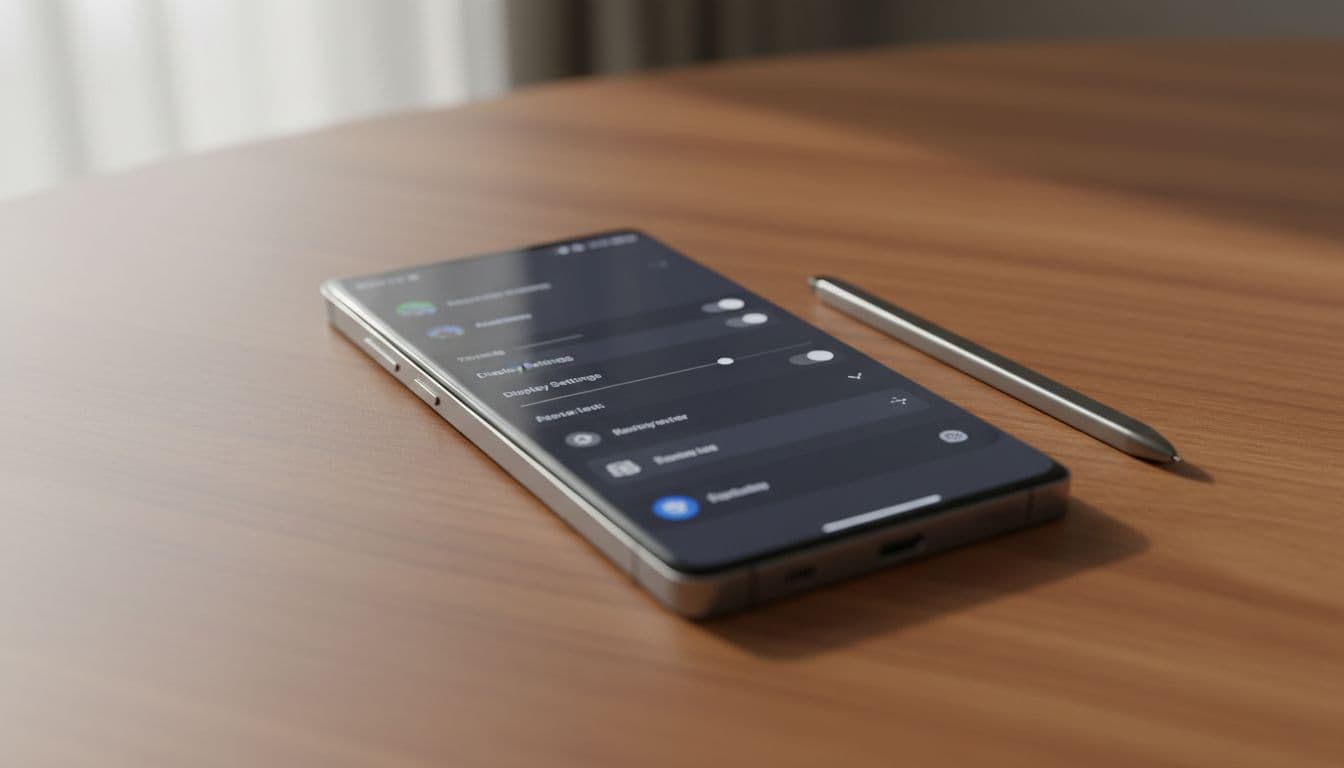
    Realistic photo of a Samsung Galaxy S26 Ultra style smartphone lying flat on a wooden desk surface with a slightly angled screen showing a blurred generic display settings interface and a stylus nearby, illuminated by soft natural window light.

    Common Samsung Galaxy S26 Ultra Screen Problems (pick your symptom)

    Match what you see to the closest symptom, then jump to the fixes below. A Samsung Galaxy S26 Ultra screen problem often looks worse at night, after updates, or right after Smart Switch.

    • Flickering: brightness “shimmers,” especially on gray backgrounds or low brightness (jump to flicker fixes).
    • Green line or pink line: a thin vertical line that stays in the same spot (jump to line fixes).
    • Touch issues: missed taps, ghost touches, or dead zones (jump-to-touch fixes).
    • Black screen but phone is on: vibrations, sounds, or calls work, but the display stays dark (jump to black screen fixes).
    • Screen glitch after update: odd colors, jittery UI, flashing panels, or stutter with device lag (jump to update fixes).
    • Brightness jumps: gets brighter or dimmer in steps, even within the same room (jump-to-brightness fixes).
    • Tint, discoloration, fuzzy text: warm or green tint, uneven tones, or text that looks soft and causes eye fatigue (jump to discoloration fixes).

    For background on the fuzzy text and comfort complaints, see this roundup of early reports on Privacy Display eye strain and fuzzy text.

    Is it software or hardware? Do these 2 quick tests

    This matters because it saves time. If the tests point to hardware, heavy troubleshooting usually won’t help. That’s when the return window or warranty becomes the safer move.

    Use these tests when you see lines, flicker, glitches, or touch-response problems. They also help with Android version issues or major updates.

    Screenshot test (takes 10 seconds)

    1. Take a screenshot (Side button + Volume down).
    2. Open the screenshot on the phone.
    3. If possible, view the same image on another device (tablet, PC, or a friend’s phone).

    How to read the result:

    • If the line or glitch shows in the screenshot file, it’s more likely software, GPU, theme, or rendering.
    • If the problem does not appear in the screenshot but you still see it on the screen, it points more to a display panel, connector, or display driver issue.

    For fuzzy text or eye strain, the screenshot often looks normal. That doesn’t prove a defect. It can be display behavior, settings, or OLED sensitivity.

    Safe Mode test (best way to rule out apps)

    Safe Mode starts the phone with Samsung’s core apps only. It helps rule out third-party launchers, accessibility overlays, screen filters, dimmer apps, and “blue light” apps.

    1. Boot into Safe Mode (method varies by model).
    2. Use the phone for 3 to 5 minutes.
    3. Check the exact screen action that triggers the issue (scrolling, typing, auto-brightness, gaming).

    Pass or fail:

    • If the issue goes away in Safe Mode, suspect an app or setting imported during setup.
    • If the issue stays, suspect a system bug, firmware glitch, or hardware.

    Realistic photo of a modern Android smartphone on a plain table, screen active in boot sequence with subtle Safe Mode indicator in the bottom corner, soft shadows, indoor natural light, high detail.
    For more context on the eye discomfort discussion regarding the S26 Ultra display, this report summarizes what owners are saying about headaches and eye strain.

    Fix order (safe steps first)

    Follow this order. After each change, test for 3 to 5 minutes. Stop if fixed.

    1. Update software (system update plus Samsung app updates).
      Why it helps: patches display drivers and System UI bugs.
      Expect: one reboot, then some warmth while apps re-index.
      Move on if: the issue returns after the next reboot.
    2. Check display settings (Eye Comfort Shield, Extra Dim, Adaptive brightness).
      Why it helps: these can change perceived sharpness, tint, and flicker feel.
      Expect: instant change, especially on white backgrounds.
      Move on if: there’s no clear improvement.
    3. Refresh rate test (60 Hz vs 120 Hz).
      Why it helps: reduces timing issues that can show as flicker or jitter.
      Expect: less smooth scrolling at 60 Hz, but more stable visuals.
      Move on if: flicker or glitches still show at 60 Hz.
    4. Always On Display test (turn off for 1 hour).
      Why it helps: rules out AOD conflicts with lock screen and brightness logic.
      Expect: no always-on clock, fewer “wake” transitions.
      Move on if: symptoms continue during normal use.
    5. Reset all settings (safe).
      Why it helps: clears bad settings imports after Smart Switch.
      Expect: Wi-Fi, Bluetooth, and preferences reset, data stays.
      Move on if: the problem repeats in Safe Mode too.
    6. Backup plus factory reset (last resort).
      Why it helps: removes deep software corruption.
      Expect: setup time, then a clean baseline for testing.
      Move on if the issue appears before installing apps; that’s a hardware sign.

    Two real-world causes people miss: case pressure along the edges and a slightly misfit protector. Also, oily fingers can cause “missed touch” that feels like a defect.

    Galaxy S26 Ultra touch screen not working (real fixes, safe order)

    First, check the signs. They help separate software from hardware fast.

    • Touch works in some apps but not others: likely an app, overlay, or accessibility setting.
    • Dead zones, no touch anywhere, or ghost touches: more likely hardware, moisture, or a failing digitizer.

    Now work in this order, testing after each step.

    1. Remove screen protector and case (test bare screen).
      What to do: peel off the protector, remove the case, then test typing.
      What to expect: better touch at edges, fewer missed taps.
    2. Clean and dry the screen.
      What to do: use a microfiber cloth, keep hands dry, avoid harsh cleaners.
      What to expect: scrolling becomes consistent because oil can “skip” touch.
    3. Restart, then test touch in Settings and in the Phone dialer.
      What to do: reboot, then try taps in Settings, and type in the dialer keypad.
      What to expect: if the dialer misses taps, it’s not “just one app.”
    4. Turn off Accidental touch protection and extra sensitivity (if enabled).
      What to do: toggle them off for a test session.
      What to expect: fewer ghost touches if the phone was over-correcting input.
    5. Safe Mode test.
      What to do: boot Safe Mode and test the same areas of the screen.
      What to expect: if touch works now, remove recent apps, launchers, and screen filters.
    6. Check for software updates (system plus Galaxy Store apps).
      What to do: update everything, then reboot.
      What to expect: touch may improve after the first hour of use.
    7. Reset all settings (safe, no data loss).
      What to do: reset settings, then test before changing display options.
      What to expect: touch becomes stable if a bad setting caused delays.
    8. Factory reset (last resort, backup first).
      What to do: reset, then test touch before restoring apps.
      What to expect: if touch fails on a clean setup, it’s likely hardware.

    A practical reference for additional steps to resolve an unresponsive screen is Technobezz’s guide to fixing an unresponsive S26 Ultra screen.

    Clear service triggers: a dead strip, no touch at all, or ghost touches that keep happening after Safe Mode and a reset.

    If touch fails in Safe Mode and you can reproduce it on demand, stop troubleshooting and start return or warranty steps.

    Fix by symptom (mini-guides)

    Use the mini-guide that matches what you see. After each change, give it a short test. Stop if fixed. If it looks like a defect (lines, black screen), record a quick photo or video for support.

    Screen flickering (Galaxy S26 Ultra screen flickering fix)

    Likely causes: refresh-rate changes, adaptive brightness and PWM sensitivity, Extra Dim, third-party dimmers, and firmware glitches after updates.
    Fixes: switch to 60 Hz, disable adaptive brightness, toggle Extra Dim off, test at 40-70 percent brightness, try Safe Mode, then reset all settings.
    Seek service: flicker occurs at normal brightness in Safe Mode, or during the boot logo.

    Macro close-up of a modern flat OLED smartphone screen displaying subtle flickering effect during fast scrolling on a dark webpage background, realistic photography with soft studio lighting and high pixel detail.

    Green line or pink line on screen (Galaxy S26 Ultra green line on screen)

    Likely causes: panel defect, connector stress, heat damage, rare driver issues.
    Fixes: run the screenshot test, remove a tight case (edge pressure), restart, let the phone cool, then update software once.
    Seek return or service: the line is not in screenshots and stays in Safe Mode. Don’t spend hours troubleshooting that pattern.
    Macro close-up photograph of a smartphone OLED screen displaying a thin faint vertical green line defect on a smooth color gradient from blue to black, with realistic high-resolution detail and neutral lighting.

    Touch screen not working (quick triage if you skipped the touch section)

    Likely causes: protector or case fit, moisture or oil, overlay apps, system bugs.
    Fixes: remove protector, clean and dry, restart, test in dialer, test Safe Mode, then reset all settings.
    Seek service: any repeatable dead zone, or no touch in Safe Mode.

    Black screen but phone is on (Galaxy S26 Ultra black screen but phone is on)

    Likely causes: display crash, brightness set too low, Always On Display confusion, System UI bug, hardware failure.
    Fixes: force restart, call the phone to confirm it’s on, plug into a charger, try Safe Mode, then update once the display returns.
    Seek service: no boot logo ever appears, or the screen stays black after force restart and a Safe Mode attempt.

    Screen glitch after update (Galaxy S26 Ultra screen glitch after update)

    Likely causes: software update bugs, corrupted settings, theme or launcher conflicts, Smart Switch carryover.
    Fixes: reboot, update Samsung apps, remove themes and launchers, test Safe Mode, then reset all settings.
    Seek service: glitches appear before any apps are installed after a factory reset.

    Brightness keeps changing (Galaxy S26 Ultra brightness keeps changing)

    Likely causes: adaptive brightness learning, Eye Comfort Shield schedules, power saving, sensor blockage from a thick protector.
    Fixes: clean the top sensor area, disable adaptive brightness for a day, check Modes and Routines, and test indoors versus sunlight.
    Seek service: changes are extreme and continue after reset all settings.

    Discoloration, tint, or fuzzy text (S26 Ultra display discoloration)

    Likely causes: Screen mode mismatch, Eye Comfort Shield, Privacy Display behavior, OLED PWM sensitivity.

    Fixes: disable Privacy Display if present, switch Natural versus Vivid to compare, turn off Eye Comfort Shield to test, try 60 Hz, and test at higher brightness.

    Seek return or service: discomfort hits fast (nausea or headaches), or the unit looks worse than a store display after settings reset.

    For examples of what owners reported and how Samsung responded in community threads, see this Samsung Community discussion on eye strain.

    People also ask (quick answers)

    Why is my Galaxy S26 Ultra screen flickering?

    It’s usually caused by refresh-rate changes, adaptive brightness behavior, or dimmer apps.
    If yes, do this: test 60 Hz, disable adaptive brightness, then check Safe Mode.

    How do I fix Galaxy S26 Ultra screen problems without a factory reset?

    Most issues improve with settings tests, updates, and Safe Mode, not a reset.
    If yes, do this: restart, remove the protector, update, then reset all settings.

    Is the green line on the Galaxy S26 Ultra a hardware defect?

    Often yes, especially if it isn’t in screenshots and stays in Safe Mode.
    If yes, do this: document it, then contact the seller or Samsung quickly.

    Can a screen protector cause touch problems on the S26 Ultra?

    Yes, a thick or poorly fitted protector can block touch and cause misses.
    If yes, do this: test bare screen, then reapply or replace with a compatible one.

    Why is my S26 Ultra screen glitching after an update?

    It’s often a conflict with themes, launchers, or cached settings after an update.
    If yes, do this: reboot, update Samsung apps, then test Safe Mode.

    Should I return or replace my Galaxy S26 Ultra because of screen issues?

    Return or replace when the issue is repeatable and survives quick tests.
    If yes, do this: use screenshot and Safe Mode results, then act within the return window.

    Why is my Galaxy S26 Ultra touch screen not working?

    Common causes include protectors, moisture, overlay apps, system bugs, or hardware failure.
    If yes, do this: clean, restart, then test Safe Mode.

    How do I fix an unresponsive touch screen on Galaxy S26 Ultra?

    Start with physical checks, then move to Safe Mode and settings resets.
    If yes, do this: remove protector, clean, restart, dialer test, Safe Mode.

    Does Safe Mode help fix Samsung touch screen issues?

    Safe Mode doesn’t “repair” the phone, but it shows if an app is causing trouble.
    If yes, do this: uninstall recent overlays, launchers, and screen filter apps.

    Common mistakes to avoid

    • Random “booster” apps: they can add overlays and create more Samsung display issues.
    • Pressing on the screen: it can worsen a panel line or make touch defects permanent.
    • Skipping updates: early firmware glitches often need a patch.
    • Factory reset too early: it wastes time if a case, protector, or setting caused it.

    Results: What improvement should look like

    A real fix feels boring, and that’s good.

    Flicker should stop during scrolling and on gray screens. Brightness should stay steady in the same room. Touch should register the same pressure across the panel. Text should look crisp enough to read without squinting or feeling strained.

    Test times that keep things simple:

    • 5 minutes after a setting change (brightness, 60 Hz, Eye Comfort Shield).
    • 1 hour after turning off Always On Display.
    • 24 hours after updates, because background optimization can settle.
    • 1 day after resetting all settings, especially if Smart Switch imported preferences.

    Stop troubleshooting and move to return or service when a line persists in Safe Mode, touch has dead zones, or the screen won’t show the boot logo.

    Conclusion

    Samsung Galaxy S26 Ultra screen problems often stem from a few repeatable causes: settings, apps, protectors, or hardware. Start with the 2-minute checklist, then run the screenshot test and a Safe Mode test. Next, follow the safe fix order and stop as soon as the screen looks normal. If hardware signs show up (lines that aren’t in screenshots, dead touch zones, or a black screen that won’t show the logo), it’s time to use the return window or warranty. Keep it simple and document what you see before contacting support.

  • Pixel 10 Lag After January 2026 Update: Fix Freezing, Crashes, and AOD Flicker

    Pixel 10 Lag After January 2026 Update: Fix Freezing, Crashes, and AOD Flicker

    If your Pixel 10 Lag After January 2026 Update started the same day you installed it, you’re not imagining it. If your Pixel 10 started lagging right after the January 2026 update, you’re not imagining it. A lot of people noticed the same kind of device lag, random crashes, and even AOD flickering or small screen glitches after updating.

    The good news is you usually do not need to factory reset right away. Below is the exact fix order I’d follow on my own phone, starting with the safest steps first so you can get your speed back fast.

    These are safe, standard Android troubleshooting steps that often fix update related slowdowns. The same steps also apply to the Pixel 10 Pro. Some people also report Wi-Fi and Bluetooth issues after the January 2026 update, so a network reset step is included if needed.

    What changed after the January 2026 update (and why your Pixel 10 feels slower)

    A phone update can feel like moving into a newly renovated apartment. Everything looks the same, but boxes are everywhere behind the scenes. For the first day or two, the system may run extra tasks that compete for speed.

    Common reasons a Pixel can feel worse right after an update include:

    • Background optimization: Android may re-optimize apps for the new build, which can raise heat and cause stutters.
    • Google Play services and Play system changes: core components update quietly and can affect app behavior.
    • Cached files acting weird: old temporary data can clash with new system code.
    • App conflicts: one outdated app (or an app with overlay permissions) can slow the whole UI.
    • Firmware glitches: some updates introduce bugs that show up as freezing, crashes, or display oddities like AOD flicker.

    Reports about the January 2026 Pixel 10 update mentioned lag and crashes in the days after rollout, including performance drops tied to system components and update timing. For context on what users described, see coverage like Pixel 10 lag and crashes after an update.

    Reality check: the first 24 to 48 hours after an update can be rough. Still, constant freezing, daily crashes, or Settings locking up usually needs troubleshooting.

    Start here (2-minute quick fixes)

    Close-up of a modern smartphone lying flat on a light wooden table, with its screen showing subtle motion blur across abstract app icons to represent slowdown or lag, captured in realistic photo style under warm indoor lighting.
    This section is meant for the moment when the phone feels “broken” and time is short. Run these in order and stop as soon as things feel normal.

    Here’s a fast reference before the details:

    Quick fix What to do What you should see Move on when
    Restart Reboot once Fewer stutters, fewer “not responding” popups Lag returns within minutes
    Update apps Update all in Play Store Problem apps crash less Freezing still happens system-wide
    Check storage Keep 10 to 15 GB free Faster app switching You already have space
    Test AOD off Disable AOD for a day Flicker stops Flicker continues with AOD off
    Battery Saver off Turn it off and test Smoother scrolling Stutter remains

    If your phone feels normal now, stop here.

    Restart your Pixel 10 (yes, it matters)

    What to do: hold the Power button, then tap Restart (or power off, wait 20 seconds, then power on).

    What you should see after: the first unlock should feel smoother. Random UI hiccups may stop, especially if a background process got stuck.

    When to stop and move on: if the phone still freezes, crashes, or lags again within 5 to 10 minutes.

    Update all apps in the Play Store

    Old app versions can crash after a system change.

    What to do: open Play Store, tap the profile icon, choose Manage apps and device, then Update all.

    What you should see after: the same apps that were crashing should open normally more often. Scrolling may improve if a launcher, keyboard, or social app was the issue.

    When to move on: if updates finish and the lag or freezing still happens across multiple apps.

    Check storage (low space causes smartphone slowdown)

    Low storage can make any phone feel like it’s dragging a heavy backpack.

    What to do: go to Settings > Storage. Aim for 10 to 15 GB free.

    Quick wins: delete large videos, clear Downloads, remove unused offline music or maps, and uninstall apps you no longer use.

    What you should see after: faster app switching and fewer reloads when jumping between camera, messages, and browsers.

    When to move on: if you already have enough free space, or freeing space doesn’t change lag.

    Turn off AOD for a test (for AOD flickering / screen glitch)

    Always-on display issues can look scary, but this is a test, not a forever change.

    What to do: go to Settings > Display > Lock screen, then toggle off Always show time and info (wording may vary).

    What you should see after: AOD flicker stops, and the screen should flash less on wake.

    When to move on: if the flicker continues even with AOD off, or if performance issues remain. For background on this symptom, see reports such as flickering Always-on Display on Pixel 10.

    Toggle Battery Saver OFF, then test again

    Battery Saver can lower performance. After an update, that “slower” feel can turn into obvious stutter.

    What to do: go to Settings > Battery > Battery Saver, then turn it off. Use the phone normally for 10 minutes.

    What you should see after: smoother scrolling and fewer delayed taps, especially in heavy apps.

    When to move on: if there’s no change, or if you need Battery Saver for a trip and can’t keep it off.

    Quick check: Is it an app problem or a system problem?

    Safe Mode is the fastest way to sort this out without guessing. It’s a fork in the road.

    If Safe Mode proves it’s an app issue, focus on app cleanup first. Don’t reset the whole phone yet.

    Try Safe Mode (fast test)

    Safe Mode runs Android with only built-in apps. It temporarily disables downloaded apps.

    What to do (common Pixel method): press and hold the Power button, then press and hold Power off, then confirm Safe Mode. After the reboot, “Safe mode” usually appears near the bottom of the screen.

    What you should see after: if the phone is smooth in Safe Mode, a downloaded app or setting is the likely cause.

    When to move on: after 5 to 10 minutes of testing basics (scrolling, opening Settings, camera, and the app drawer).

    Close-up realistic photo of two relaxed hands resting on a wooden desk beside a modern smartphone standing upright, displaying a generic boot menu with abstract unreadable shapes and blurred safe mode indicator.

    If lag is gone in Safe Mode (most common cause)

    If the lag disappears in Safe Mode, a recent app install or update often explains it.

    Action order (stop as soon as performance is back):

    1. Uninstall the last 3 apps you installed or updated (one at a time).
    2. Restart normally, then test for a few minutes after each removal.
    3. Switch back to Pixel Launcher for testing if you use a third-party launcher.
    4. Disable apps with overlay-style permissions, such as screen dimmers, accessibility overlays, clipboard managers, and some password helpers.

    Common troublemakers include launchers, VPNs, battery saver apps, “night screen” overlays, keyboard apps, and automation tools.

    Avoid “cleaner,” “RAM booster,” and “phone optimizer” apps. They often increase background activity and make freezes worse.

    What you should see after: fewer launcher stutters, faster unlock, and fewer random app crashes.

    When to move on: if you removed likely apps and lag still appears in Safe Mode, it’s time for system-level fixes.

    If lag still happens in Safe Mode (system-level fixes)

    If Safe Mode doesn’t help, the issue is less likely to be a downloaded app. Next, focus on system cleanup and resets that usually don’t erase personal data.

    This matters because some January 2026 reports described Settings freezing, plus Wi-Fi and Bluetooth toggles failing around update timing. If connectivity is part of the problem, the network reset step below is worth trying. For a broader view of what the January update aimed to address, see summaries like January 2026 Pixel update fixes.

    Fix order (do these one by one)

    This is the core flow. Run one step, then test for a bit. Don’t stack five changes at once.

    Also check temperature while testing. If the phone feels hot, let it cool and remove a thick case. Heat can cause stutter and app reloads.

    Clear cache for problem apps (safe place to start)

    What to do: Settings > Apps > See all apps, choose the app that freezes (often Pixel Launcher, a keyboard, or a social app), then Storage & cache > Clear cache. Don’t use “Clear storage” unless you’re okay signing in again.

    What you should see after: fewer app hangs and fewer “not responding” popups inside that app.

    How long to test: 30 minutes of normal use.

    When to stop and move on: if the lag is system-wide and not tied to one app.

    Reset app preferences (fixes disabled system apps and defaults)

    What to do: Settings > Apps > See all apps, tap the three-dot menu, then Reset app preferences (wording may vary).

    What you should see after: odd behavior like missing notifications, broken defaults, or blocked background activity may clear up.

    How long to test: 30 to 60 minutes.

    When to stop and move on: if you don’t notice any change, or if Settings still freezes.

    Check for system updates and Google Play system updates, then reset network settings if Wi-Fi or Bluetooth is flaky

    What to do (system update): Settings > System > Software updates > System update. Install any available update, then restart.

    What to do (Play system update): Settings > Security and privacy > Updates > Google Play system update (path may vary). Install if offered.

    What you should see after: bug fixes may reduce crashes, improve touch response, or smooth animations. Rolling back is usually not simple, so focus on forward updates.

    If Wi-Fi or Bluetooth drops, or if Settings hangs on Network pages: run a network reset at Settings > System > Reset options > Reset Wi-Fi, mobile and Bluetooth.

    What it changes: it does not erase photos or apps, but it will forget saved Wi-Fi networks and Bluetooth pairings.

    When to stop and move on: if connections stabilize and the phone stops hitching when switching networks.

    Reduce the work your phone has to do (animations and a few connection features)

    What to do (easy option): Settings > Accessibility > Color and motion > Remove animations (or similar toggle).

    If you already use Developer options: don’t change random items. Only adjust animation scales:

    • Window animation scale: 0.5x
    • Transition animation scale: 0.5x
    • Animator duration scale: 0.5x

    If you have network weirdness: turn off Adaptive Connectivity for one day, then retest.

    What you should see after: faster-feeling app opens and less janky scrolling. If AOD flicker returns, keep AOD off for now.

    When to stop and move on: if the phone feels smoother again during normal use.

    Last resort: backup, then factory reset (only if the phone is still freezing every day)

    Factory reset is worth considering only when Safe Mode didn’t help and the phone still freezes or crashes daily.

    What to do first (quick backup checklist):

    • Confirm Google One backup is current.
    • Make sure Google Photos (or your photo app) finished syncing.
    • Save 2FA codes (Authenticator export, backup codes).
    • Backup chats (for example, WhatsApp backup).
    • Note bank app logins and any device approvals you may need again.
    • If you use eSIM, save carrier details (some carriers require a new QR code).

    Then reset: Settings > System > Reset options > Erase all data (factory reset).

    What you should see after: smoother setup, fewer crashes, and normal launcher performance.

    When to stop and get help: if the phone is still broken after the reset and all updates, contact Google support or your retailer. A deeper firmware issue or hardware fault is possible.

    People also ask: quick answers about freezing, crashes, and AOD flicker

    Why is my Pixel 10 lagging after the January 2026 update?

    It often happens because the phone is finishing background setup, or an app and cached data don’t play well with the new build. If the lag lasts more than 48 hours, troubleshooting helps. Some reports tied the timing to system component changes like Play services updates.

    How do I fix Pixel 10 lag after an update without factory reset?

    Start with a restart, update all apps, free storage, and test AOD off. Next, use Safe Mode to confirm if a downloaded app is the cause. After that, clear cache for problem apps and try a network reset if connections are unstable.

    Does the Google Play system update cause Pixel lag?

    It can, because Play system components and Play services updates can change how apps run in the background. A Play system update is also easier to check than to roll back. This is why checking for updates and then testing one change at a time matters.

    Why is my Pixel 10 crashing after the update?

    Crashes often come from one app that hasn’t updated for the new software, or from corrupted app cache. Safe Mode is the fastest test. If Safe Mode helps, remove recent apps and anything with overlay permissions.

    How do I stop AOD flickering on Pixel 10?

    Turn off Always-on Display for a day to confirm it’s the trigger, then keep it off until a later patch or setting change fixes it. A reboot and “Remove animations” may also reduce related screen glitches.

    Will a future update fix Pixel 10 performance issues?

    It may, especially if the cause is a software bug that affects many users. Still, the safe fixes in this guide can reduce the impact now. Checking weekly for system and Play system updates helps, without spending hours doom-scrolling patch threads.

    Common mistakes to avoid when your Pixel 10 feels broken after an update

    • Don’t install random “RAM booster” or cleaner apps. They often add background load.
    • Don’t factory reset first. Safe Mode can save hours and keep data intact.
    • Don’t change Developer options blindly. One toggle can create new problems.
    • Don’t ignore storage and app updates. Low space and outdated apps are common causes.
    • Don’t follow risky ADB or sideload steps unless you understand them, since mistakes can complicate support.

    Results and expectations: what “fixed” looks like, and when to wait for a patch

    “Fixed” usually looks boring, in a good way. Scrolling stays smooth. Apps don’t reload as often. Random freezes stop. Heat and battery use settle down.

    Your phone should feel smoother within 10 to 60 minutes after the quick fixes. Still, some post-update background work can take a day.

    Waiting for a patch makes sense when you tried the safe steps, the issue is reduced but not gone, and it started right after the update. In that case, keep workarounds in place (AOD off, problematic app removed, animations reduced) while watching for the next monthly update or Play system update. Some coverage also tracks update-side fixes for Pixel glitches, such as Pixel update fixes and known glitches.

    Get help sooner if crashes repeat, Settings won’t open, Wi-Fi and Bluetooth toggles fail, or problems continue after a factory reset.

    A single modern smartphone lies face-up on a dark wooden bedside table at night, its screen emitting a subtle dim glow from an always-on display with faint abstract shapes. Low light from a bedside lamp casts soft shadows, highlighting the phone's matte back and screen reflections in a cozy blurred bedroom background.

    Conclusion

    When Pixel 10 lag after January 2026 update hits, the fastest path is simple: restart and update apps, free space and test AOD off, then use Safe Mode to confirm app vs system. After that, follow the fix order and stop as soon as performance returns. Factory reset belongs at the end, not the start.

    Comments help others. Include what worked, your model (Pixel 10 or Pixel 10 Pro), your Android version, and your country.

    SEE ALSO: Mobile Data Not Working After Update Android? Fix in 5 Min

  • Pixel Android 16 Problems: Fix WiFi, Battery Drain, App Crashes, and Bluetooth Issues

    Pixel Android 16 Problems: Fix WiFi, Battery Drain, App Crashes, and Bluetooth Issues

    A fresh Android update can feel like an oil change that somehow made the engine louder. After installing Pixel Android 16, some Google Pixel owners see new glitches that were not there yesterday.

    This guide is for Google Pixel 6 and newer in the UK and USA, running Android 16 (stable or beta). It focuses on safe, common fixes in the right order, starting with the fastest checks.

    It covers four problems that occur most frequently after major Android updates: Wi-Fi issues, battery drain and overheating, app crashes, and Bluetooth problems. These are usually normal post-update hiccups, not permanent damage, and they rarely need risky “hacks.”

    Pixel Android 16 troubleshooting at home with a Google Pixel phone held in two hands, screen slightly blurred.
    Here’s a quick triage table to pick the right first move.

    Problem Likely cause Try first Next step
    WiFi keeps disconnecting Router hiccup, saved network glitch Restart phone and router Reset Wi-Fi, mobile, and Bluetooth
    WiFi connected but no internet DNS or time sync issue, ISP outage Toggle Airplane mode, forget/rejoin WiFi Test another network, contact ISP
    Battery draining fast Post-update background work, one rogue app Check Battery usage, update top app Restrict background, Adaptive Battery
    Bluetooth not pairing/dropping Old pairing, multipoint conflict Forget device, re-pair clean Reset Wi-Fi, mobile, and Bluetooth
    Apps crashing/freezing App update mismatch, corrupted cache Update apps, clear cache Safe Mode test, reinstall app
    Phone overheating/lag Indexing, poor signal, heavy apps Reboot, reduce screen brightness Check signal, update Play system

    Pixel Android 16 WiFi not working: drops, slow speeds, or connected but no internet

    A realistic high-resolution photo of a single Google Pixel phone centered on a clean desk next to a home WiFi router, with soft natural lighting and no people, cables, or extra objects.
    WiFi problems after an Android version change often come down to one of two things: a saved network profile that no longer behaves, or a router that needs a reset. “Connected but no internet” can also be a time, DNS, or ISP issue.

    Try this first

    • Toggle WiFi off and on (Settings > Network & internet > Internet).
    • Restart the phone. A simple reboot clears stuck network services.
    • Restart the router or modem. Unplug it for 30 seconds, then plug it back in.
    • Turn off any VPN (Settings > Network & internet > VPN). VPNs can break sign-in pages.
    • Toggle Airplane mode on for 10 seconds, then off. This resets radios quickly.
    • Forget and rejoin the network: Settings > Network & internet > Internet > select your WiFi > Forget, then reconnect and re-enter the password.

    Next
    If Pixel WiFi connected but no internet Android 16 shows up, test one more thing: open a browser and try a plain site (example: a news site) instead of an app. Some apps cache “offline” states.

    If that didn’t work
    Move to the advanced checks below. They help separate a phone problem from a router or ISP issue.

    Last resort
    Reset network settings (steps below). It is safe, but it deletes saved WiFi and Bluetooth pairings.

    Try this first: quick WiFi resets that take under 2 minutes

    Start with the simplest resets, as they resolve most “WiFi keeps disconnecting” cases.

    1. Toggle WiFi off, wait 5 seconds, toggle it back on.
    2. Restart the Pixel, then retry the network once it fully boots.
    3. Power-cycle the router or modem, as it may be holding a stale lease.
    4. Disable VPN temporarily, then test again on the same network.
    5. Toggle Airplane mode, then reconnect to WiFi.
    6. Forget the Wi-Fi network, then rejoin it, then type the password again.

    If it still fails: advanced WiFi checks (bands, hotspot test, and network reset)

    Band and interference issues are common, especially in apartments and older routers.

    First, try switching bands. Connect to 5 GHz if it’s available. If you only have 2.4 GHz, temporarily turn off Bluetooth and test again, because 2.4 GHz WiFi and Bluetooth can interfere.

    Next, isolate the source:

    • Test a different WiFi network (work, coffee shop, or a friend’s router).
    • Test a friend’s hotspot. If your Pixel works fine there, the home router or ISP is the likely culprit.

    Also check time sync. Wrong time can block internet sign-in.

    • Settings > System > Date & time > turn on Set time automatically and Set time zone automatically.

    If nothing changes, reset network settings:

    • Settings > System > Reset options > Reset Wi-Fi, mobile & Bluetooth

    This removes saved WiFi networks and Bluetooth pairings. After the reset, reconnect and test again.

    Hotspot note: if the Pixel hotspot is not working on Android 16, restart the phone, then toggle hotspot off and on (Settings > Network & internet > Hotspot & tethering). If other devices still cannot join, test the hotspot in a different location. Some carriers limit hotspot or require an enabled plan.

    Beta users should expect more bugs. If you’re on a beta build, review the latest fixes listed in reports such as the Android 16 QPR3 Beta updates.

    What worked for most people
    Most success comes from forgetting and rejoining WiFi and doing Reset Wi-Fi, mobile & Bluetooth. Those two steps fix the saved-profile problems that often show up after updates.

    Pixel Android 16 battery drain and overheating: stop the fast drain without killing your favorite features

    Realistic close-up photo of a Google Pixel smartphone on a wooden table connected loosely to a charging cable, with warm indoor lighting and subtle shadows.
    Battery issues after a major update are common because the phone performs extensive background “housekeeping”. Think photo indexing, app optimization, and resyncing data. For many people, Pixel Android 16 battery drain improves within 24 to 48 hours.

    If the phone feels hot, treat that as a signal. Phone overheating after an Android 16 update often stems from a single resource-intensive app, poor cellular signal, or heavy background activity while charging.

    Try this first: check what’s draining your battery, then fix the top 1 to 2 apps

    1. Charge to 100% once, then reboot. This helps reset battery reporting.
    2. Go to Settings > Battery > Battery usage and look at the top app.
    3. Update that app in the Play Store. Many crashes and drains get fixed quickly.
    4. Restrict background use for obvious offenders: Settings > Apps > (app) > Battery > select Restricted (or turn off “Allow background usage,” depending on model).
    5. Reduce “always-on” extras for one day: the always-on display, hotspot, and any constant-listening features you do not need.
    6. Turn off unneeded notifications for the draining app. Notifications can keep apps awake.

    A helpful optional feature: Adaptive connectivity can reduce network power use in some cases. The idea is simple: the phone tries to pick more efficient connections when possible. See the explainer on Android’s Adaptive Connectivity and battery impact.

    If it keeps draining overnight, deeper fixes that still keep your data safe

    An overnight drain usually indicates one of three things: background app activity, a weak signal, or a system process that got stuck after the update.

    • Turn on Adaptive Battery: Settings > Battery > Adaptive Battery.
    • Review scanning toggles: Settings > Location > Location services (or search “scanning”) and turn off WiFi scanning or Bluetooth scanning if you do not need them.
    • Lower screen power: reduce brightness, shorten Screen timeout (Settings > Display).
    • Check signal strength. Poor reception makes the phone work harder. If the drain is worst at home, test WiFi calling (carrier feature) or place the phone near a window.
    • Remove and re-add widgets that update frequently (e.g., weather, stocks). A bad widget can loop.
    • Test in Safe Mode to confirm a third-party app is the cause:
      • Hold the power button, then press and hold Power off, then tap Safe Mode.
      • Use the phone for a bit. If the drain stops, uninstall recent apps after rebooting normally.
    • Install pending updates:
      • Settings > System > Software update
      • Settings > Security & privacy > Updates > Google Play system update

    Heat warning: if the phone gets hot while charging, remove the case, stop using it, and charge with an official or certified charger and cable. Heat plus fast charging can stack up quickly.

    What worked for most people
    Battery drain often improves after 24 to 48 hours, plus fixing one top draining app in Battery usage. Turning on Adaptive Battery also helps many Pixels.

    Apps crashing after Android 16 update: get your apps stable again (without losing logins)

    Most app crashes after a major update come from mismatched app versions or messy cached files. The goal is to fix stability without wiping your logins first.

    Try this first

    • Restart the phone. This clears stuck app processes.
    • Update the crashing app, then update everything: Play Store > profile icon > Manage apps & device > Update all.
    • Force stop the app: Settings > Apps > See all apps > (app) > Force stop.
    • Clear cache (not data): Settings > Apps > See all apps > (app) > Storage & cache > Clear cache.
    • Check storage space. When storage is nearly full, apps crash more frequently. Settings > Storage.

    If the app requires background processing (messaging, ridesharing, fitness tracking), avoid overrestricting it. Overly strict battery settings can make it crash or miss alerts.

    For beta testers, app instability can be a real issue. Reports like Pixel testers seeing Android 16 beta app crashes suggest some issues depend on the app developer catching up.

    Try this first: quick app cleanup that fixes most crashes

    1. Restart the Pixel, then open the app once.
    2. Update that app in the Play Store.
    3. Update all apps, because shared components can matter.
    4. Force stop, then relaunch.
    5. Clear cache only. Save “Clear storage” for later since it can sign you out.
    6. Free up a few gigabytes of storage if the phone is close to full.
    7. If the app must run in the background, set App battery to Optimized instead of Restricted.

    If crashes keep happening: Safe Mode test, reinstall, and system updates

    Safe Mode is a clean test. It temporarily disables third-party apps. If crashes stop in Safe Mode, a downloaded app is likely causing trouble.

    • Enter Safe Mode (same steps as above), then try the crashing app again.
    • If it works in Safe Mode, reboot normally and remove recent installs first. Pay extra attention to launchers, accessibility tools, screen filters, and antivirus apps.
    • Reinstall the crashing app as the last app-focused step. This often fixes corrupted files.
    • Update the system components:
      • Settings > System > Software update
      • Settings > Security & privacy > Updates > Google Play system update

    If the crash is tied to Android 16 beta, the best short-term move may be to wait for the next beta release or switch back to stable on a spare device.

    What worked for most people
    Updating all apps, then clearing cache for the one crashing app solves a lot of cases. When that fails, a Safe Mode test usually points to the real cause.

    Pixel Android 16 Bluetooth issues: pairing failures, dropouts, and audio glitches

    Bluetooth problems are usually due to pairing history, a low accessory battery, or multipoint conflicts (one headset connected to two devices). Cars add another layer because infotainment systems vary widely.

    Try this first

    • Toggle Bluetooth off and on (Settings > Connected devices > Connection preferences > Bluetooth).
    • Restart the Pixel.
    • Charge the headset, speaker, watch, or car adapter. A low battery causes dropouts.
    • Turn off Bluetooth on nearby devices that might auto-connect.
    • Forget and re-pair clean: Settings > Connected devices > Previously connected devices > choose the device > Forget, then pair again.

    Next
    Test another accessory. If a second headset works fine, the issue is likely the first accessory, not the phone. If nothing pairs, focus on the Pixel settings.

    If that didn’t work
    Reset connections:

    • Settings > System > Reset options > Reset Wi-Fi, mobile & Bluetooth

    This wipes Bluetooth pairings, so plan a few minutes to re-pair devices.

    Last resort
    For cars, delete the pairing on both the Pixel and the car, then re-add it. If the car has a firmware update option, apply it.

    Try this first: re-pair the right way and rule out the accessory

    1. Toggle Bluetooth, then restart the phone.
    2. Fully charge the accessory, then put it into pairing mode again.
    3. Disable Bluetooth on any nearby phones or tablets for a minute.
    4. Forget the device in Previously connected devices, then pair from scratch.
    5. Pair a second accessory to confirm whether Pixel Bluetooth not pairing Android 16 is device-specific.

    If it keeps dropping: fix conflicts, reset connections, and check car audio settings

    • Turn off multipoint on the accessory if it supports it. Multipoint is convenient, but it can cause switching loops.
    • Keep it simple with audio settings. If your Pixel shows an easy toggle for LE Audio on your model, try turning it off once to test.
    • Reset Wi-Fi, mobile & Bluetooth (path above), then re-pair only one audio device at first.
    • For cars, remove any old pairings, then verify that the car’s Bluetooth profile is set to “Phone + Media Audio.”

    Beta users should also submit feedback in the Android Beta Feedback app. It helps fix land faster.

    What worked for most people
    A clean re-pair, plus charging the accessory, fixes most dropouts. When pairing is stuck, Reset Wi-Fi, mobile & Bluetooth has the highest success rate.

    Results you can expect, plus mistakes that make Android 16 issues worse

    Most common fix outcomes

    • Resetting Wi-Fi, mobile & Bluetooth often stops WiFi drops and Bluetooth pairing loops.
    • “Connected but no internet” often clears after router reboot plus forgetting and rejoining WiFi.
    • Battery drain often improves after 24 to 48 hours and limiting 1 or 2 top apps.
    • Overheating often improves after reducing screen brightness and stopping heavy background apps.
    • App crashes often stop after app updates plus clearing cache, without needing a full reset.

    Common mistakes to avoid

    • Factory resetting too early, because it wipes data and often isn’t needed.
    • Skipping app updates after updating Android, which leaves compatibility gaps.
    • Restoring a bad backup right away, which can bring back the same problem.
    • Changing many settings at once, which makes it hard to tell what helped.
    • Ignoring router or ISP issues when WiFi is the real culprit.

    When to update again vs wait: in February 2026, Pixel updates can be security-focused, not bug-fix heavy. Some issues may only improve with a later patch or a QPR release. If you’re on beta and the phone is unstable, waiting for the next beta can help, but it also carries risk. Coverage of recent beta fixes, including battery changes, appears in write-ups like reports on Android 16 beta battery drain fixes.

    Escalate when basics fail. If WiFi fails on all networks, Bluetooth will not pair with any device, or heat is severe even at idle, contact Google support or your carrier (especially if mobile signal looks abnormal).

    Android 16 Stable vs Android 16 Beta (QPR): Which is better for troubleshooting?

    Category Android 16 Stable Android 16 Beta (QPR)
    Stability Higher for most users Varies by build
    Bug risk Lower Higher
    New features timing Later Earlier
    Who should use it Most people, primary phone Testers, spare phone users
    Best for troubleshooting Best baseline for diagnosis Useful for testing upcoming fixes

    People Also Ask: quick answers for Pixel Android 16 update issues

    Is Android 16 stable on Pixel?

    Android 16 stable is usually reliable, but stability still depends on the Pixel model and installed apps. Beta builds can run well, yet bugs show up more often and fixes may arrive in the next beta patch.

    • Check Settings > System > System update for the latest patch.
    • Update all apps in the Play Store.
    • Reboot once after updates finish.
    • If you’re on beta, expect more app compatibility issues.
    • Test a problem in Safe Mode to separate apps from the system.

    Why is my Pixel battery draining after Android 16?

    Right after an update, the phone runs extra background tasks, which can drain battery for a day or two. If Pixel battery draining overnight Android 16 continues past 48 hours, a single app or weak signal is often the reason.

    • Settings > Battery > Battery usage, find the top app.
    • Restrict background for obvious offenders (Settings > Apps > App battery).
    • Check mobile signal, poor reception drains power fast.
    • Reduce brightness and shorten screen timeout.
    • If it heats while charging, remove the case and use a certified charger.

    How do I fix Wi-Fi issues on a Pixel running Android 16?

    Start by ruling out the router, then reset the phone’s saved network profile. Most Wi-Fi issues after updates are caused by stale settings, not by broken hardware.

    • Restart the router or modem (unplug for 30 seconds).
    • Forget and rejoin the WiFi network.
    • Disable VPN and retry.
    • Try another WiFi network or a friend’s hotspot.
    • Reset Wi-Fi, mobile & Bluetooth if it keeps failing.

    Why are apps crashing after the Android 16 update?

    Apps may need updates to match the new Android version, and cached data can clash with new app code. In most cases, the fix is an update plus cache cleanup, not a factory reset.

    • Update the crashing app, then update all apps.
    • Force stop the app, then reopen it.
    • Clear cache (Settings > Apps > Storage & cache).
    • Free storage space if it’s nearly full.
    • Use Safe Mode to confirm whether another app is causing trouble.

    How do I fix Bluetooth issues on the Pixel after an Android update?

    Bluetooth problems often come from old pairings, low accessory battery, or device conflicts. A clean re-pair solves most cases, and a connection reset helps when pairing gets stuck.

    • Toggle Bluetooth and restart the phone.
    • Charge the accessory, then try pairing again.
    • Forget the device and re-pair from scratch.
    • Turn off Bluetooth on nearby devices to avoid auto-connect fights.
    • Reset Wi-Fi, mobile & Bluetooth if nothing pairs.

    Should I factory reset my Pixel after updating to Android 16?

    Usually no. Targeted fixes (updates, cache clears, network reset, Safe Mode) solve most problems without wiping data. A factory reset makes sense only after backups, and only when issues are severe and repeatable.

    • Consider it if Safe Mode is stable but normal mode is not.
    • Back up photos, messages, and authenticator apps first.
    • Write down important logins and 2-factor methods.
    • After resetting, set up fresh first, then restore carefully.
    • Avoid restoring everything at once if you suspect a bad app caused the issue.

    Conclusion

    Most post-update glitches clear with a calm, basic routine: restart the phone, update apps, and reset connections when needed. For WiFi and Bluetooth, Reset Wi-Fi, mobile & Bluetooth is often the turning point. For battery and heat, give it 24 to 48 hours, then fix the top draining app in Battery usage. If problems continue on Pixel Android 16, check for new patches, contact Google support or your carrier, and treat a factory reset as the final step after a full backup. Share your Pixel model, stable or beta, the exact issue, and what you already tried.

    SEE ALSO: Mobile Data Not Working After Update Android? Fix in 5 Min

  • Pixel Android 16 WiFi Not Working (Fix Disconnecting, No Internet, Slow Speed)

    Pixel Android 16 WiFi Not Working (Fix Disconnecting, No Internet, Slow Speed)

    When pixel android 16 wifi not working shows up right after an update, it can feel like the phone lost its most basic skill. This fix-first guide is for Google Pixel 6 and newer in the UK and USA on Android 16 (stable or beta). It covers WiFi disconnects, devices connected but without internet, slow speeds, and a WiFi toggle that won’t turn on. The steps start safe and simple, then move to stronger resets only if needed. Try them in order, and stop when it works, for broader related issues, see Pixel Android 16 problems and fixes.

    Quick fixes to try first (2 minutes, no risk)

    Realistic close-up photo of a Google Pixel smartphone held in one hand, screen displaying blurred Android Wi-Fi settings menu against a blurred home office background.
    Run this short checklist before changing deeper settings:

    • Airplane mode on/off
    • Restart phone
    • Restart router (unplug 30 seconds)
    • Forget network + reconnect
    • Disable VPN temporarily
    • Check for system update + Google Play system update

    If WiFi broke right after Android updates, community reports often match these symptoms. For example, Google’s Pixel help forum has multiple threads on connection failures after Android 16, including can’t connect to Wi‑Fi after Android 16 update.

    Pick your problem so you don’t waste time

    Use the label that matches what’s happening on the mobile device:

    A) WiFi disconnecting/dropping
    Drops when the screen locks, or it flips to LTE or 5G.

    B) Connected but no internet
    Shows “Connected,” but pages and apps won’t load.

    C) Slow WiFi speed
    Other devices are fast, but the Pixel crawls.

    D) WiFi won’t turn on
    The WiFi toggle is gray, turns itself off, or won’t stay on.

    Step-by-step fixes for Pixel Android 16 WiFi not working

    Android version changes can shift network drivers, flip battery and data toggles, or corrupt a saved network profile. VPNs and Private DNS can also clash after an update. The goal here is to fix the most common causes without tools, tech jargon, or risky resets.

    Pixel WiFi keeps disconnecting on Android 16 (drops at home, switches to mobile data)

    After an update, WiFi drops often come from Adaptive Connectivity behavior, a damaged WiFi profile, or an app that manages network switching. This is especially common when a phone roams between 5 GHz and 2.4 GHz bands.

    1. Turn off Adaptive Connectivity
      Go to Settings > Network & internet > Adaptive connectivity, then turn it off.
    2. Forget the network and reconnect
      Go to Settings > Network & internet > Internet > Wi‑Fi, tap the network, then Forget. Rejoin and re-enter the password.
    3. Toggle Randomized MAC only if needed
      This changes the device identity your router sees, which can help if the router saved a bad profile for the phone.
      Go to Settings > Network & internet > Internet > Wi‑Fi > (gear next to network) > Privacy > Device MAC, then switch between Randomized MAC and Device MAC.
    4. Switch to 2.4 GHz temporarily
      2.4 GHz is often slower, but it can be more stable through walls and at longer range. Use it for a day to test stability.
    5. Safe Mode test to rule out apps
      Press and hold the Power button, then press and hold Power off, then tap OK to enter Safe Mode. Test WiFi for a few minutes. Restart to exit Safe Mode.
    6. Reset Wi‑Fi, mobile & Bluetooth
      Go to Settings > System > Reset options > Reset Wi‑Fi, mobile & Bluetooth.

    If the phrase “Pixel WiFi keeps disconnecting at home, Android 16” fits the situation, focus on steps 1 through 4 first, since they address most home stability issues. Stop here if it works.

    A wider wave of early-2026 update complaints also mentions WiFi and Bluetooth instability on some models, as summarized by Nextpit’s report on Pixel update WiFi and Bluetooth failures.

    WiFi connected but no internet on Android 16 Pixel (connected, nothing loads)

    This can happen when the phone keeps a “connected” WiFi link but can’t reach DNS or the gateway, often due to Private DNS, VPN rules, or a corrupted network entry after an update.

    1. Test another device on the same WiFi for 60 seconds
      If a laptop or another phone can’t browse either, the router or ISP is likely the issue. If other devices work, keep going.
    2. Disable VPN and Private DNS temporarily
      Go to Settings > Network & internet > VPN, then disconnect.
      Next, go to Settings > Network & Internet> Private DNS, then set it to Off or Automatic.
    3. Forget and reconnect
      Go to Settings > Network & internet > Internet > Wi‑Fi, select the network, tap Forget, then rejoin.
    4. Reset network settings
      Go to Settings > System > Reset options > Reset Wi‑Fi, mobile & Bluetooth.
    5. Optional: Try a simple DNS change
      If Private DNS is needed, set Private DNS to a well-known provider (for example, Google DNS). If it doesn’t help, switch back to Automatic.

    The most common version of this complaint is “Pixel WiFi connected but no internet Android 16,” and steps 2 through 4 usually clear it. Stop here if it works.

    For similar cases reported by users, see Google’s community thread on can’t use Wi‑Fi or Bluetooth since Android 16 update.

    Gotcha: Private DNS and VPN settings can stay “on” across updates, even when they stop working well. Turning them off for two minutes is a fast proof test.

    Pixel Android 16 slow WiFi (good signal, bad speed)

    Slowdowns after an update often come from band steering (5 GHz vs 2.4 GHz), interference, or a phone setting that prefers mobile data. Sometimes the phone is “fine,” but it’s clinging to a weak 5 GHz signal.

    1. Compare speed near the router vs far away
      If it’s fast near the router but slow across the house, the issue is range or band selection, not the phone itself.
    2. Turn off Adaptive Connectivity
      Go to Settings > Network & internet > Adaptive connectivity, then turn it off and re-test.
    3. Turn off Bluetooth for 2 minutes
      Bluetooth can add interference in some rooms, especially with older routers. Toggle it off briefly to test.
    4. Use the right band (5 GHz vs 2.4 GHz)
      5 GHz is usually faster at short range. 2.4 GHz often holds a connection better through walls.
      If “Pixel WiFi won’t connect to 5GHz Android 16” appears, try forgetting and rejoining the network, restarting the router, then testing 2.4 GHz to confirm the phone still works.
    5. Router reboot and a simple channel check
      Reboot the router. If the router app has an “Auto channel” option, turn it on. If it offers channels, try a different one and re-test.

    Stop here if it works.

    Realistic photograph of a Google Pixel smartphone lying flat on a light-colored kitchen table, screen displaying a blurred WiFi speed test app, with a half-filled coffee mug and open notebook nearby in morning natural light.

    Pixel Android 16 WiFi keeps turning off or the WiFi toggle won’t turn on

    Some Android updates can break WiFi and Bluetooth for some users. When the WiFi toggle grays out or flips off, it can be more than a simple settings conflict. Still, a few safe steps are worth trying first.

    1. Restart twice
      Restart once, wait 30 seconds, then restart again. A second reboot can finish post-update cleanup.
    2. Safe Mode test
      Enter Safe Mode (press and hold the Power button, then tap OK). If WiFi works there, an app is likely interfering.
    3. Reset Wi‑Fi, mobile & Bluetooth
      Go to Settings > System > Reset options > Reset Wi‑Fi, mobile & Bluetooth.
    4. Check for updates (both types)
      Go to Settings > System > System update.
      Also check Settings > Security & privacy > System & updates > Google Play system update.
    5. If still broken, treat it like a bug
      If “Pixel WiFi disabled and won’t turn on Android 16” matches your situation, waiting for a patch and contacting support are often better than a factory reset. A reset can waste time and may not help if the driver is the problem.

    Stop here if it works.

    For examples that sound similar, Google’s community has reports like Wi‑Fi turns itself off after Android 16 update and more severe cases such as Wi‑Fi and Bluetooth totally dead.

    What usually fixes it, plus mistakes to avoid while you troubleshoot

    Most users don’t need every step. These three fixes solve a large share of cases:

    • Forget and reconnect to the WiFi network
    • Turn off VPN and Private DNS for a quick proof test
    • Reset Wi‑Fi, mobile & Bluetooth (network reset)

    Two common mistakes slow things down. First, don’t factory reset early. It can be stressful, and it might not fix driver bugs. Second, don’t burn through mobile data while testing. If the Pixel keeps switching to cellular, look in Settings > Network & internet > Internet for a gear icon or network preferences, then disable any option like “switch to mobile data” (wording can vary by model and carrier).

    Beta users should expect more glitches. When a stable version is available for the same Android version, moving back can improve WiFi reliability, but this guide avoids downgrade steps.

    Here’s the practical difference many users see:

    Topic Android 16 Stable Android 16 Beta
    Stability Higher for daily use Can vary by build
    Bug risk Lower overall Higher overall
    Update frequency Less frequent More frequent
    Who it’s for Most Pixel owners Testers and early adopters

    Photorealistic front view of a modern white mesh WiFi router on a wooden home desk in a cozy living room, with green status LEDs, upright antennas, and Ethernet cable, soft sunlight and blurred bookshelf background.
    Quick answers (People Also Ask) for Pixel WiFi problems on Android 16

    Why is Pixel WiFi not working after the Android 16 update?

    It usually happens because an update changed network behavior or a saved WiFi profile got corrupted.

    • Adaptive Connectivity may cause switching or drops
    • VPN or Private DNS can block internet access
    • Forgetting and rejoining can rebuild the network profile
    • A network reset often clears stubborn issues
    • If the WiFi toggle won’t turn on, it may be a software bug
    • Support is the right next step when the basics don’t change anything

    How do I fix the WiFi disconnecting on Pixel Android 16?

    Turn off the settings that push the phone to switch networks, then rebuild the WiFi connection.

    • Disable Adaptive connectivity
    • Forget the network, then rejoin
    • Try 2.4 GHz for stability through walls
    • Test Safe Mode to rule out apps
    • Use Reset Wi‑Fi, mobile & Bluetooth if needed
    • Stop when it’s stable again

    Why does my Pixel say “connected” but have no internet?

    The phone is connected to the router, but DNS, VPN, or routing is blocking traffic.

    • Test another device first to confirm it’s not the ISP
    • Turn off VPN and set Private DNS to Automatic
    • Forget and reconnect to the WiFi network
    • Reset Wi‑Fi, mobile & Bluetooth
    • Reboot the router if other devices also fail

    Does resetting network settings delete saved WiFi passwords?

    Yes, it removes saved WiFi networks and Bluetooth pairings, but it doesn’t delete photos or apps.

    • Saved WiFi networks and passwords: removed
    • Bluetooth pairings: removed
    • Some network preferences: reset
    • Photos, messages, and apps: unchanged
    • Have the WiFi password ready before doing it
    • Note any VPN settings so they can be re-added

    Should I turn off Adaptive Connectivity on Pixel?

    Yes, turning it off is a good test when WiFi drops or the phone keeps switching to mobile data.

    • It can push the phone to change networks too aggressively
    • Path: Settings > Network & internet > Adaptive connectivity
    • If stability improves, leave it off for a day
    • Turn it back on later if battery life matters more
    • Watch for fewer drops when the screen locks

    Is Android 16 causing WiFi bugs on Pixel phones?

    Yes, for some users, especially when the WiFi toggle breaks or WiFi and Bluetooth fail together.

    • Not every Google Pixel series model is affected
    • A sudden failure right after an update can point to a bug
    • If other devices work fine on the same router, suspect the phone
    • Check for both system updates and Google Play system updates
    • Contact support if the toggle won’t stay on
    • Avoid factory reset unless it’s the last option

    Conclusion

    Most WiFi issues clear up with quick fixes, then symptom-based steps, then a network reset. In many cases, forgetting the network or turning off VPN and Private DNS is enough. Still, a broken WiFi toggle can be an Android 16 bug, and waiting for an update may be the smartest move. If pixel android 16 wifi not working is still the problem after these steps, use the full Pixel Android 16 troubleshooting guide to keep tracking safe fixes and known issues.

  • Mobile Data Not Working After Update Android? Fix in 5 Min

    Mobile Data Not Working After Update Android? Fix in 5 Min

    If you’re dealing with Mobile Data Not Working After Update Android, you’re not alone. It usually hits right when you need your phone the most. Wi Fi works at home, but the moment you step outside, nothing loads. WhatsApp will not send, Instagram will not refresh, and Maps cannot pull directions when you need them. That stress is real, especially when your phone is how you get around, stay in touch, and finish school or work tasks.

    This issue is common after a system update. Android can reset mobile network settings, switch the data SIM on dual SIM phones, or change APN settings (the carrier’s internet settings that power mobile internet). You may notice 4G or 5G disappear, get stuck on E or H+, or see “connected” but still have no internet. The fixes below start with the safest, fastest steps. Most take 1 to 5 minutes, and the early steps will not delete your photos, apps, or messages.

    Mobile Data Not Working After Update Android? Here’s the Fix

    Follow these steps in order, and stop as soon as your connection returns. After each fix, give your phone 20 to 30 seconds to reconnect and watch for the 4G/5G icon to come back. If you use prepaid service, travel often, or run dual SIM, pay extra attention to the SIM and APN steps, because updates change those most often.

    Try This First (30 Seconds)

    Quick toggle: Swipe down from the top of your screen. Turn on Airplane mode, wait 10 seconds, then turn it off.
    This refreshes your network connection and often fixes minor glitches caused by the update.

    Quick Checks (1-Minute Fixes)

    Start here. These simple steps solve most cellular data issues without touching any complicated settings.

    1. Toggle Mobile Data On and Off

    Swipe down from the top of your screen to open quick settings. Tap the mobile data icon to turn it off. Wait 5 seconds. Tap again to turn it back on.

    What this does: Forces your phone to reconnect to your carrier’s network. This refreshes the connection that the update may have interrupted.

    If you see the 4G or 5G icon appear at the top, you’re done. Stop here.

    2. Restart Your Phone

    Hold the power button. Tap “Restart” or “Reboot.” Wait for your phone to fully turn back on.

    What this does: Clears temporary system glitches that updates sometimes create. Takes about 1 minute total.

    3. Check Your Signal Bars

    Look at the top of your screen. Do you see signal bars? If there’s an exclamation mark, “no service,” or an “X,” the problem may be coverage, a SIM issue, or a carrier outage.

    Try moving to a different spot. If you’re indoors, step outside for a minute to test. Updates can make weak signal areas feel worse because your phone re-registers on the network.

    4. Test With Another App

    Open Chrome, YouTube, or any browser, not just WhatsApp or one app. Sometimes one app has a cache issue while mobile data is actually working.

    If other apps work fine, the problem is app-specific. Clear that app’s cache in
    Settings > Apps > [App name] > Storage then tap Clear cache.

    Common Fixes for Mobile Data Not Working After Update Android

    Person checking mobile network settings on Android smartphone after system update
    Checking data settings is the most common solution after Android updates

    If quick checks didn’t work, the update likely changed one of these settings. Don’t worry, these are safe to adjust and won’t delete your stuff.

    5. Check Which SIM Is Set for Data (Dual SIM Users)

    This is one of the most common reasons for data loss after updates on dual SIM phones. Updates sometimes switch your data to the wrong SIM slot.

    Here’s how to fix it:

    Step 1: Open Settings

    Step 2: Tap “Network & internet” (or “Connections” on Samsung phones)

    Step 3: Tap “SIMs” or “SIM card manager”

    Step 4: Look for “Mobile data” or “Preferred SIM for data”

    Step 5: Make sure it’s set to the correct SIM card (the one you actually use for internet)

    What this fixes: Puts your data connection back on the right SIM. This solves the issue instantly for many dual SIM users.

    If your data comes back after this, you’re done.

    6. Reset Your APN Settings

    APN stands for Access Point Names. These are the settings your phone uses to connect to your carrier’s mobile internet. Updates can reset these to generic defaults that don’t work with your specific carrier.

    Here’s the quick fix:

    Step 1: Open Settings

    Step 2: Go to “Network & internet” > “Mobile network” (Samsung: “Connections” > “Mobile networks”)

    Step 3: Tap “Access Point Names” or “APN”

    Step 4: Tap the three dots menu in the corner

    Step 5: Tap “Reset to default”

    Your phone will restart the connection. Wait 30 seconds and check if your data icon appears.

    What this fixes: Restores the correct internet connection settings for your carrier. This works for many prepaid SIM users and smaller carriers.

    You can also check DownDetector to see if other people are reporting issues with your carrier.

    Note: On some brands (Xiaomi, Oppo, Realme), you may need to manually enter APN settings.
    Search “[your carrier name] APN settings” and use the official carrier values.

    7. Change Preferred Network Type

    Sometimes updates switch your network preference from 4G/5G down to 3G or even 2G. This can make data extremely slow or completely unusable.

    Step 1: Open Settings

    Step 2: Go to “Network & internet” > “Mobile network”

    Step 3: Tap “Preferred network type”

    Step 4: Select “5G/4G/3G auto” or “LTE/4G” depending on what your carrier supports

    What this does: Forces your phone to use the fastest available network. You should see the 4G or 5G icon appear at the top of your screen within seconds (if coverage is available).

    8. Turn Off Data Saver Mode

    Updates sometimes enable Data Saver, which limits background data. This can make it feel like data isn’t working.

    Step 1: Open Settings

    Step 2: Go to “Network & internet” > “Data Saver”

    Step 3: Turn it off

    What this fixes: Allows your apps to use mobile data normally again.

    9. Check Data Limit Settings

    Your phone might think you’ve exceeded your monthly data limit and shut off mobile internet to protect you from extra charges.

    Step 1: Open Settings

    Step 2: Go to “Network & internet” > “Data usage”

    Step 3: Check if there’s a data warning or limit set

    Step 4: Turn off “Set data limit” or increase the limit

    10. Toggle VoLTE Setting

    VoLTE (Voice over LTE) helps with call quality but can sometimes cause odd carrier behavior after updates, depending on your network.

    Step 1: Open Settings

    Step 2: Go to “Network & internet” > “Mobile network”

    Step 3: Look for “VoLTE calls” or “Enhanced 4G LTE”

    Step 4: Toggle it on if it’s off, or off if it’s on, then test your data

    Deeper Fixes (Still Safe, Won’t Delete Your Stuff)

    Android phone settings screen showing network reset option for fixing data issues
    Network reset is safe and fixes most stubborn connection problems after updates

    If nothing above worked, try these. They’re still safe. You won’t lose photos, messages, or apps.

    11. Reset Network Settings

    This is the most effective fix for persistent Android mobile data problems after system updates. It resets all network-related settings to defaults.

    Step 1: Open Settings

    Step 2: Go to “System” > “Reset options” (Samsung: “General management” > “Reset”)

    Step 3: Tap “Reset Wi-Fi, mobile & Bluetooth”

    Step 4: Confirm and restart your phone when it finishes

    What you’ll lose: Saved Wi-Fi passwords and paired Bluetooth devices. You’ll need to reconnect manually.

    What you won’t lose: Photos, apps, messages, contacts, and downloads stay exactly as they are.

    What this fixes: Clears network configurations that the update may have changed or corrupted. This solves a large number of stubborn data issues.

    This is your best bet if you’ve tried everything else.